
Beyond Impact
How I'm rethinking success for local journalism

It has been a year since my last newsletter.
I’d love to tell you I learned a new language, or how to vibe code, or did something that sounds intentional in retrospect. The truth is I was trying to figure out what I actually thought about journalism and whether the thing I’d spent my entire professional life doing still made sense in the world as it currently exists.
Turns out that takes a while.
When I last wrote, I had not yet joined The LA Local, the nonprofit newsroom I am now leading. I was recruited by Michele Siqueiros, the CEO, and who I can only describe as my sister from another mister. She is as passionate about systems change and Los Angeles as I am.
She recruited me with the offer of a lifetime: design a new kind of local newsroom where trust comes first. Why trust? Because nobody is going to care about your big investigation into city hall if they don’t know who you are, what your values are, and how you work. It’s why creators are pulling in audiences that legacy media can’t.
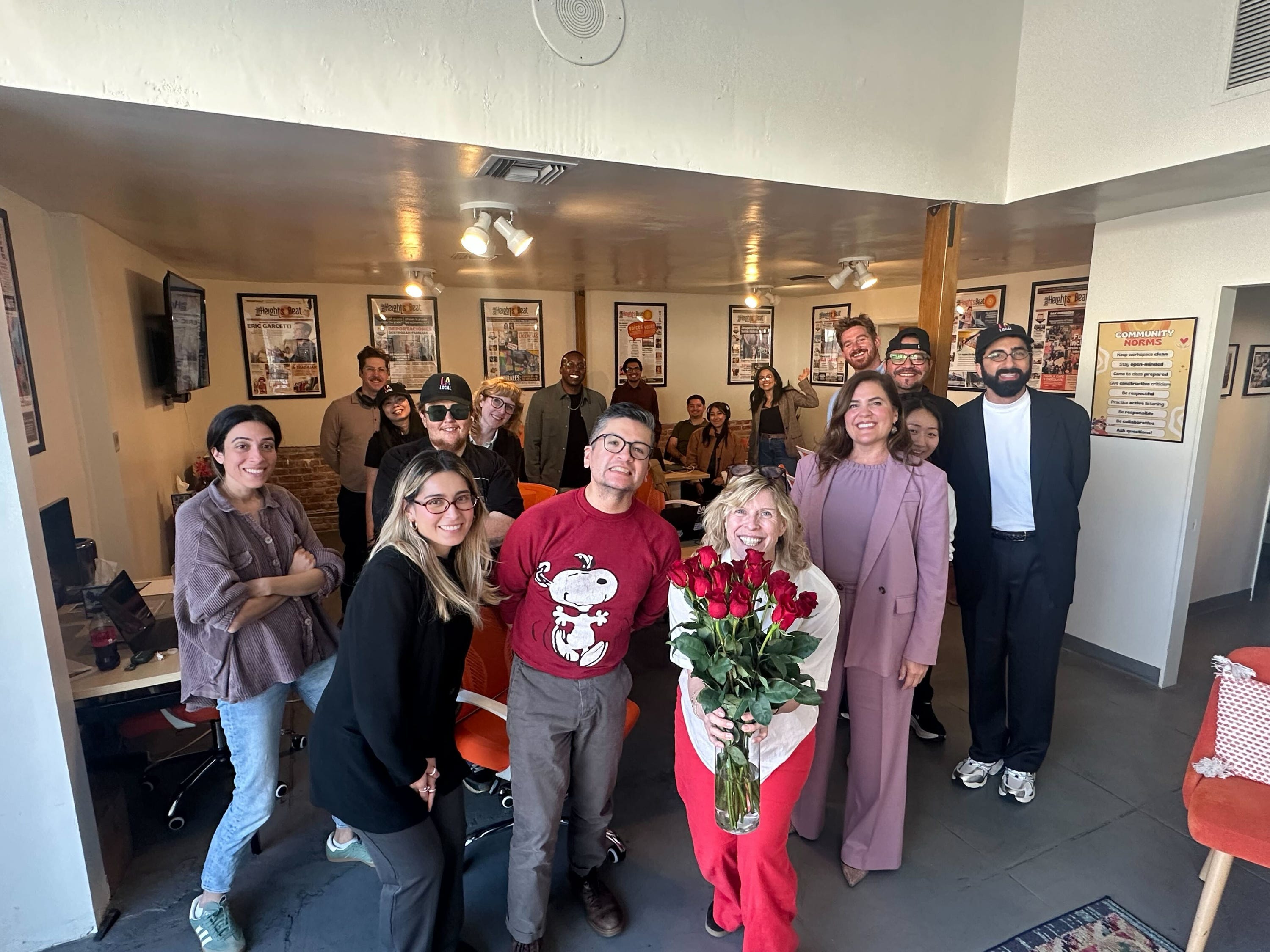
The LA Local is built around a simple idea: the neighborhood is where democratic life actually happens. It’s where you run into the same people at the park, the coffee shop, the school pickup — and those repeated encounters are how trust forms, weak ties grow, and civic culture gets built. It’s the level where you can attend a meeting and have your voice change the outcome, and see that change is possible. That belief is what we’re trying to cultivate. So we’ve embedded reporters directly into Boyle Heights, Koreatown, Pico-Union, Westlake, South LA, and Inglewood — not to cover these communities from the outside, but to become part of them. The goal isn’t just to keep people informed. It’s to give them more ways to participate in the decisions that shape their own neighborhoods, to be more connected, with a stronger sense of meaning and belonging.
So how do we get there?
Last week, I was on a Zoom call with several colleagues at The LA Local. They are strategic, mission-driven and very good at their jobs.
We were trying to answer one question: What does impact mean for us, and how do we track it?
We’ve been moving fast. Hiring reporters, launching newsletters, building social accounts. The dashboards are full. But the things we most need to know, like whether people feel more connected to their neighborhoods, whether they trust us, or whether our journalism makes them feel less alone does not get easily tracked in a dashboard or survey.
For instance, if a reader saw one of our stories about a community running club and decided to join, how would we know that our work inspired them? If someone felt reconnected to their neighborhood after seeing a story about their old high school, how would that show up?
We are tracking the metrics we can explain. Not necessarily the ones that matter.
Bill Burnett and Dave Evans, in Designing Your Life, write about something they call the dysfunctional belief. It’s the assumption that is so baked into how we operate that we’ve stopped questioning it. It’s just the water we swim in, the air we breathe.
In journalism — especially in public media and nonprofit news — our dysfunctional belief is this: impact equals success.
Think about the LA Metro.
By many measurable standards, it’s working. Trains run reliably. Ridership is growing. Routes connect one part of the county to another.
But for most of its history, Angelenos didn’t feel connected by it in the same way New Yorkers do with their subway system. We pass through each other’s neighborhoods without ever belonging to them. You could ride the E Line from Santa Monica to East LA and still have no sense of the people sitting next to you, or the communities outside the window.
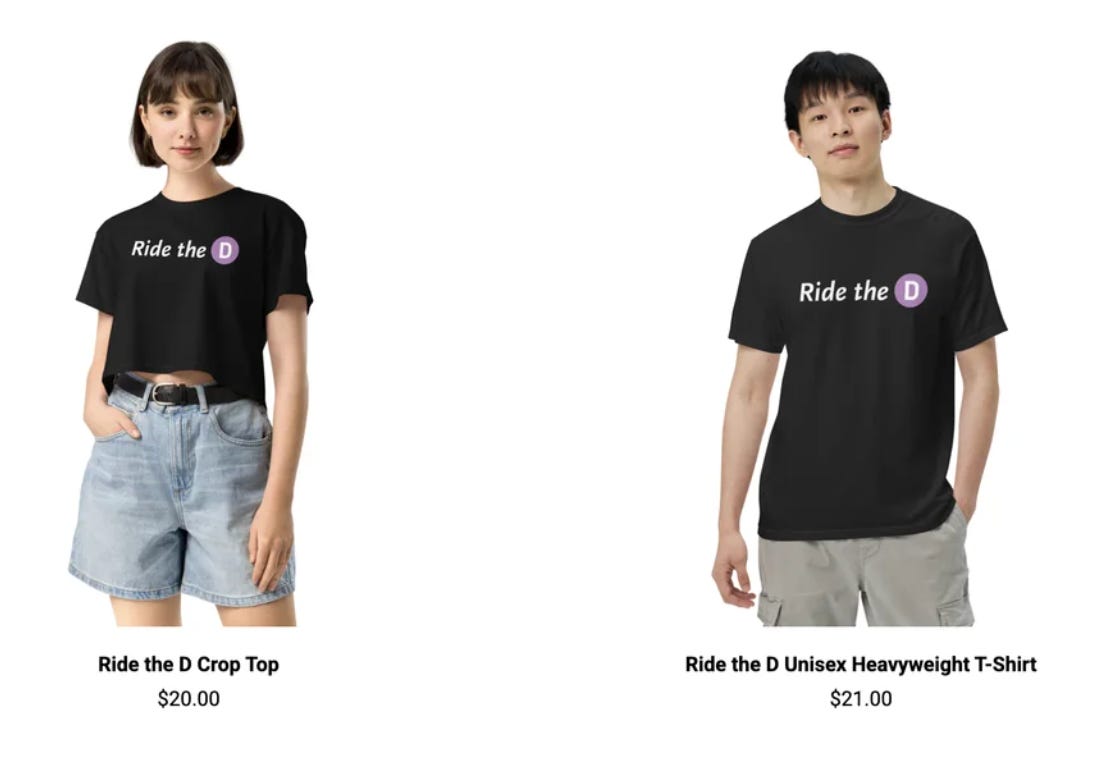
But that may be changing. When a Reddit user mocked up a ‘Ride the D’ shirt when the D line extension was announced. Metro saw it, credited the source, made the shirt, and watched it quickly sell out. Suddenly people who had never thought twice about transit were proud to be associated with it. Metro didn’t solve the problem of belonging through infrastructure. They solved it by letting the community in on the joke. Or as my colleague Leezel Tanglao describes it, ‘if you know, you know.”
That’s the difference between impact and meaning.
Impact, as we’ve inherited it from the philanthropic sector, is about outcomes you can document. Stories published, audiences reached and policies changed. It’s a framework built for accountability, and it’s not wrong. But it measures the train running, not whether anyone feels like they’re connecting to the city while riding it.
A story can change a policy and still leave the people most affected feeling like they were used as data points. A newsroom can win a Pulitzer and still have communities that feel no connection to it.
Meaning, belonging, and connection are what happen when people recognize themselves in the work. When journalism makes someone feel less alone in this city, more rooted in their neighborhood, seeing that others share their same concerns. These things don’t show up in a dashboard.
People are avoiding the news, not because they don’t care but because it makes them feel helpless. So meaning and belonging aren’t ‘soft’ add-ons to impact in local journalism. They’re a precondition for it. You can’t move people who don’t feel like the work is for them.
Burnett and Evans would call our current approach a gravity problem — something we treat as immovable when it’s actually just a choice someone made a long time ago that we no longer question. We didn’t choose impact as our north star because it was the truest expression of what journalism is for. We chose it because funders understand it. Because boards can evaluate it. Because it can show scale in a way those individual moments cannot.
“We chose the reader we can explain”
Heike Scherer writes about media and product design in his most excellent newsletter, First Belonging. He recently wrote, “We didn’t choose the reader we serve. We chose the reader we can explain.”
The reader we can explain clicks, subscribes, fills out the survey. She shows up in the dashboard. But she’s not the only reader we can serve. The person that read our list of running clubs and decided to try one? She may not share, or comment but she tried to form a connection with like-minded neighbors because of our work.
But our current dashboards can’t see her.
Liz Kelley Nelson found the same gap at the ecosystem level. Her Project C research mapped the news landscape in Chicago and turned up roughly 100 sources nobody had indexed because they didn’t fit the industry’s definition of news. She created a new category to capture them: Community Utility. They are the information providers that function more as essential resources than traditional newsrooms. A resource is something people reach for because it helps them live. It doesn’t need to drive engagement. It just needs to be there.
Some prompts for discussion
How we define success is not a neutral choice. It shapes who we hire, what we cover, which communities we serve. Right now, most of our definitions of success were designed for a different problem. We’re building the future of local journalism on top of them anyway.
So we need to push for change, including the tools we use to track success.
I don’t have a framework. Just a sense of directionality and some prompts, including:
If we removed all our current metrics tomorrow, what would we actually want to know about the people we’re serving? What would tell us our journalism is making their lives better — not just more informed?
Who in our communities are our dashboards not seeing? What would it take to find them?
What is one thing we do that no algorithm, no aggregator, no AI summary could replicate — because it requires a human being who belongs in LA?
How might we work backwards from a person, not a metric? We could design and follow one person for a quarter and let the quest for connection, belonging and meaning drive our daily work.
How do we protect work that doesn’t have a clear and immediate return on investment? Listening sessions that don’t lead to actionable tips, talks given to local organizations, editorial staff holding office hours at a local coffee shop just to be known.
What did the staff learn about their communities every week? How do we know if we are getting it right?
We haven’t solved it. We don’t yet have metrics that can track meaning and belonging. But I think we’re asking the right question: What does it mean to make a place feel like it belongs to the people who live in it? And then to build newsrooms, workflows, and cultures organized around that answer.
If Metro can figure it out with a crop top, surely we can, too.
Acknowledgements:
This essay was inspired by ideas from Bill Burnett and Dave Evans’ books How to Live a Meaningful Life and Designing Your Life, the work Joy Mayer leads at Trusting News, Heike Scherer’s Substack First, Belonging, Liz Kelley Nelson of Project C and Metro coverage by Alissa Walker, founder of Torched LA. If you are not already following their work, please do.
I used Claude.ai to help me sharpen the structure of this essay, draw distinctions between impact, meaning, connection and belonging and to generate some of the prompts for readers.
With gratitude
I am grateful for a group of people who have listened as I threw out half-baked notions, asked smart questions, pushed back at the right moments, or simply stayed in the conversation long enough for something to clarify. They include Jen Brandel, Umbreen Bhatti, Marsha Cooke, Loretta Chao, Dave Burdick, Monica Lozano, Zainab Shah, Suzy Jack, Leezel Tanglao, Ariel Zirulnick, Colin Maclay, Jon Abbott, Melanie Sill, Charley Johnson, John Davidow, Sitara Nieves, Celeste LeCompte, Elizabeth Hansen Shapiro, Jake Shapiro, Megan Garvey, Joy Mayer, Tim Griggs, Doug Smith, Tran Ha, Kevin Phelan, Mary Walter Brown, Pat Ward, Corey Ford, Sarah Alvarez, Tonya Mosley and Fiona Morgan. If you see yourself in what I wrote, it’s because you helped me see it first.